
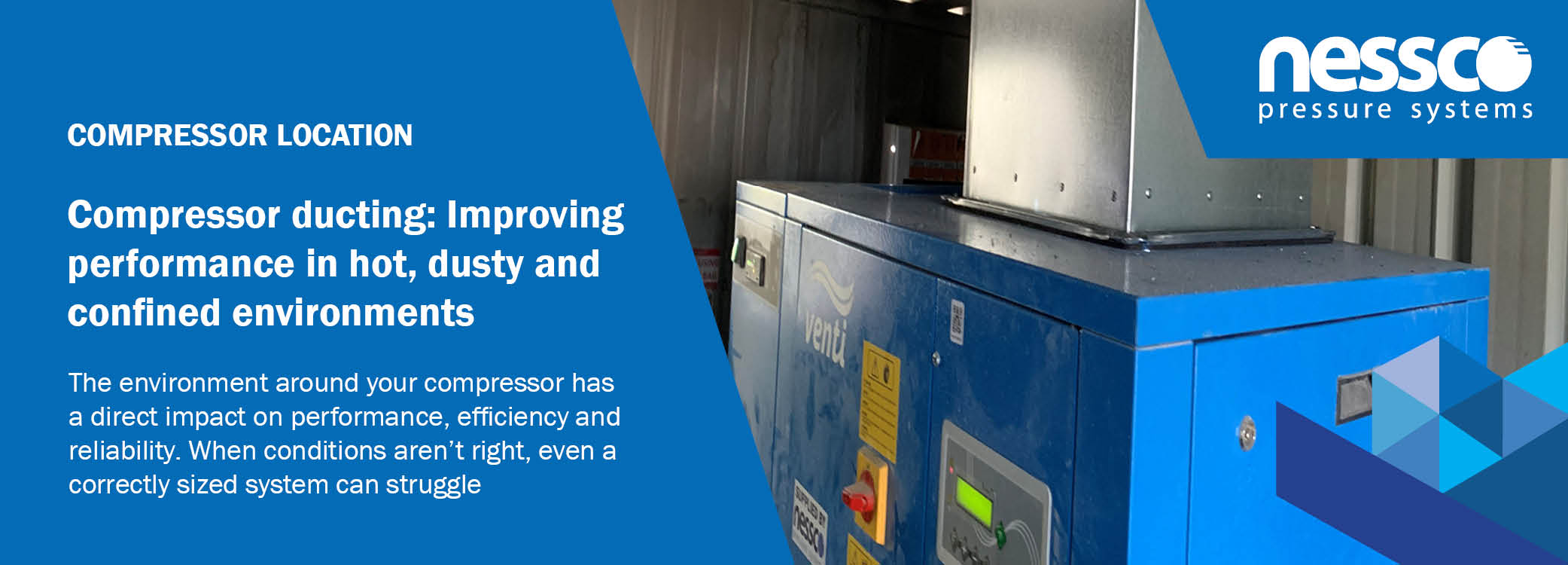
Compressor ducting: Improving performance in hot, dusty and confined environments
Does your compressor operate in hot, dusty or confined conditions?
It could be working harder than it needs to.
The environment around your compressor has a direct impact on performance, efficiency and reliability. When conditions aren’t right, even a correctly sized system can struggle.
How environment affects compressor performance
Compressed air systems rely on stable conditions to operate efficiently.
If the surrounding area is too hot or poorly ventilated, heat builds up quickly. As temperatures rise, the cooling system becomes less effective, increasing load on the compressor.
In dusty or dirty environments, contaminants affect filters, coolers and internal components. This means the system has to work harder to deliver the same air output.
Over time, this can lead to:
- Increased wear on key components
- Higher energy consumption
- Reduced system efficiency
- More frequent servicing requirements
- Greater risk of breakdowns or unplanned downtime
These issues often develop gradually and aren’t always obvious until performance starts to drop off.
Why heat management is important
Heat is one of the most common issues we see in compressed air systems.
Every compressor generates heat during operation. If that heat isn’t removed from the surrounding area, it builds up and starts to impact:
- Motor performance
- Cooling system efficiency
- Oil separation and carryover
- Dryer performance
- Overall system reliability
Managing that heat is key to keeping your system operating as it should.
A practical solution: compressor ducting
One of the most effective ways to manage heat and improve airflow is through ducting.
Rather than allowing hot air to build up around the compressor, ducting directs it away from the system and out of the space.
What ducting helps achieve:
- Lower ambient temperatures around the compressor
- Improved airflow within the compressor room or enclosure
- More stable operating conditions
- Reduced load on the system
This allows the compressor to operate closer to its design conditions.
Case study: ducting installation in Hazelmere
Working with our fabrication contractor, we installed ducting in an existing compressor house for our client, Swan Materials in Hazelmere.
The system was operating in a confined space, with heat build-up impacting performance and placing additional strain on key components.
By improving airflow and removing hot air from the enclosure, we were able to create a more stable operating environment.
The result:
- Improved cooler cleanliness
- Lower ambient temperatures within the compressor house
- More consistent operating conditions, supporting performance and reliability while reducing oil carryover
- Better dryer performance due to reduced temperatures
- Improved ventilation, helping extend the lifespan of internal components such as flexible hoses, plastics, auxiliary lines and tubing
This type of change doesn’t alter the compressor itself, but it can make a noticeable difference to how the system performs day to day.
When should you consider compressor ducting?
Ducting isn’t required for every system, but it’s worth considering if:
- Your compressor operates in a confined or enclosed space
- Ambient temperatures regularly run high
- Energy consumption has increased without a clear cause
- Components are wearing faster than expected
- The system struggles to maintain consistent performance
In many cases, these are environmental issues rather than equipment faults.
Ducting vs other solutions
Ducting is one option, but it’s not the only approach.
Depending on your setup, solutions may include:
- Improving ventilation
- Reconfiguring airflow within the compressor room
- Relocating the compressor
- Installing ducting to manage heat discharge
A site-specific assessment is the best way to determine what will have the most impact.
Read more about the importance of your compressor’s location in our blog: Correct compressor location: maximising performance and reducing operating costs
Improving efficiency starts with the environment
Compressed air performance isn’t just about the equipment itself.
Installation, airflow and environment all play a role in how efficiently your system operates over time.
Addressing these factors can improve reliability, reduce load on the system and help control running costs.
Need help assessing your compressor setup?
If your compressor is operating in conditions that make it work harder than it should, it’s worth reviewing your setup.
Our service team can assess your system, recommend practical improvements and manage the solution from start to finish.
Call 1300 290 638 or email info@nesscopressure.com.au to book a site assessment.