
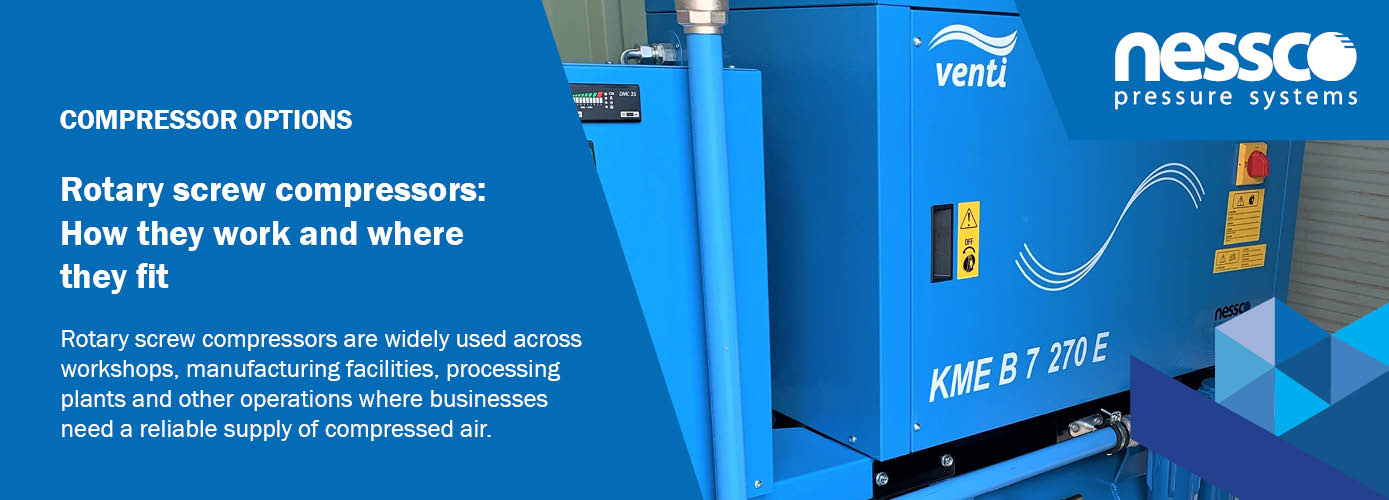
Rotary Screw Air Compressors: How They Work and Where They Fit
Rotary screw air compressors are widely used across workshops, manufacturing facilities, processing plants and other industrial applications where businesses need a reliable supply of compressed air.
Unlike a piston compressor, a rotary screw compressor uses two rotating screw elements to compress air. This design makes screw compressors well suited to applications with regular or continuous compressed air demand.
But choosing a compressor isn’t simply a matter of selecting a motor size.
Air demand, operating pressure, hours of use, working environment and changes in demand can all influence which compressor will best suit your application.
How does a rotary screw compressor work?
A rotary screw compressor draws air through an inlet filter and into the compression element.
Inside the air end, two interlocking rotors turn in opposite directions. As the rotors turn, the space between them reduces, compressing the air before it moves through the rest of the system.
In an oil-injected rotary screw compressor, oil helps lubricate, seal and cool the compression process. The compressor then separates the oil from the compressed air before the air continues downstream.
From there, the system may include an air receiver, dryer, filtration and condensate management equipment depending on the application and required air quality.
Why are rotary screw compressors used in industry?
Rotary screw compressors suit businesses that need compressed air regularly throughout the working day.
Depending on the compressor and application, benefits can include:
- Reliable compressed air for sustained demand
- Continuous-duty operation
- Lower operating noise than many piston compressors
- Compact installation options
- Efficient operation when correctly selected
- Different configurations to suit a wide range of industrial requirements
They are commonly used to supply pneumatic tools and machinery, production equipment, workshops, processing operations and other equipment that relies on compressed air.
Fixed speed or variable speed?
One of the important decisions when selecting a rotary screw compressor is whether the application suits a fixed speed or variable speed drive (VSD) compressor.
A fixed speed compressor operates its motor at a constant speed and typically loads and unloads in response to system pressure. This can suit applications where compressed air demand remains relatively consistent.
A VSD compressor adjusts motor speed to better match changing compressed air demand.
Neither option is automatically right for every application.
Understanding how much air your operation actually uses, and how that demand changes throughout the day, helps determine the most suitable compressor.
For larger systems or businesses considering a compressor upgrade, a compressed air audit can provide useful information about demand, pressure and how the existing system is operating.
Compressor sizing matters
Installing a larger compressor isn’t necessarily better.
An incorrectly sized compressor can increase energy consumption, create unnecessary cycling and affect the way the overall compressed air system operates.
When selecting a compressor, we consider factors including:
- Required airflow
- Operating pressure
- Current and future air demand
- Operating hours
- Demand fluctuations
- Compressor location and ventilation
- Air quality requirements
- Existing receivers, dryers and filtration
- Potential future expansion
Looking at the complete system helps ensure the compressor suits the application rather than simply replacing one machine with another of a similar size.
Don’t overlook where the compressor will operate
The compressor room can have a significant effect on reliability.
Rotary screw compressors generate heat while operating and need adequate ventilation to remove it. Hot, dusty or confined conditions can place additional strain on the compressor and its cooling system.
The compressor also needs sufficient access for routine servicing and repairs.
Where heat is difficult to manage, ducting can help direct hot discharge air away from the compressor room. Correct positioning and ventilation should form part of the installation planning process, rather than being considered after the compressor is installed.
Regular servicing helps protect your compressor
A rotary screw compressor contains a range of serviceable parts that wear over time.
Depending on the compressor, operating hours and manufacturer requirements, servicing may include checking or replacing items such as:
- Air and oil filters
- Air/oil separators
- Lubricant
- Belts or drive components
- Valves
- Hoses
- Cooling system components
- Electrical components
Regular servicing also gives technicians an opportunity to identify developing problems before they contribute to an unexpected breakdown.
Service intervals vary between manufacturers and compressor models, so maintenance should follow the requirements of the equipment and take its operating conditions into account.
Choosing the right rotary screw compressor
There is no single compressor that suits every business.
At Nessco Pressure Systems, we supply and service rotary screw compressors for businesses across Perth and regional WA. We work with a range of compressor brands and sizes, allowing us to consider the requirements of the application rather than limiting the solution to one particular machine.
We can help with new compressor selection, system design and installation, servicing, repairs, overhauls and compressor rental.
If you’re replacing an existing compressor, expanding production or aren’t sure whether your current compressor still suits your air demand, speak with our compressed air specialists.
Call Nessco Pressure Systems on 1300 290 638 or view our range of air compressors to discuss your requirements.